
Multi-Car Pileups on Georgia Highways and How Liability Is Determined
Hoffspiegel Law Blog
May 15, 2026
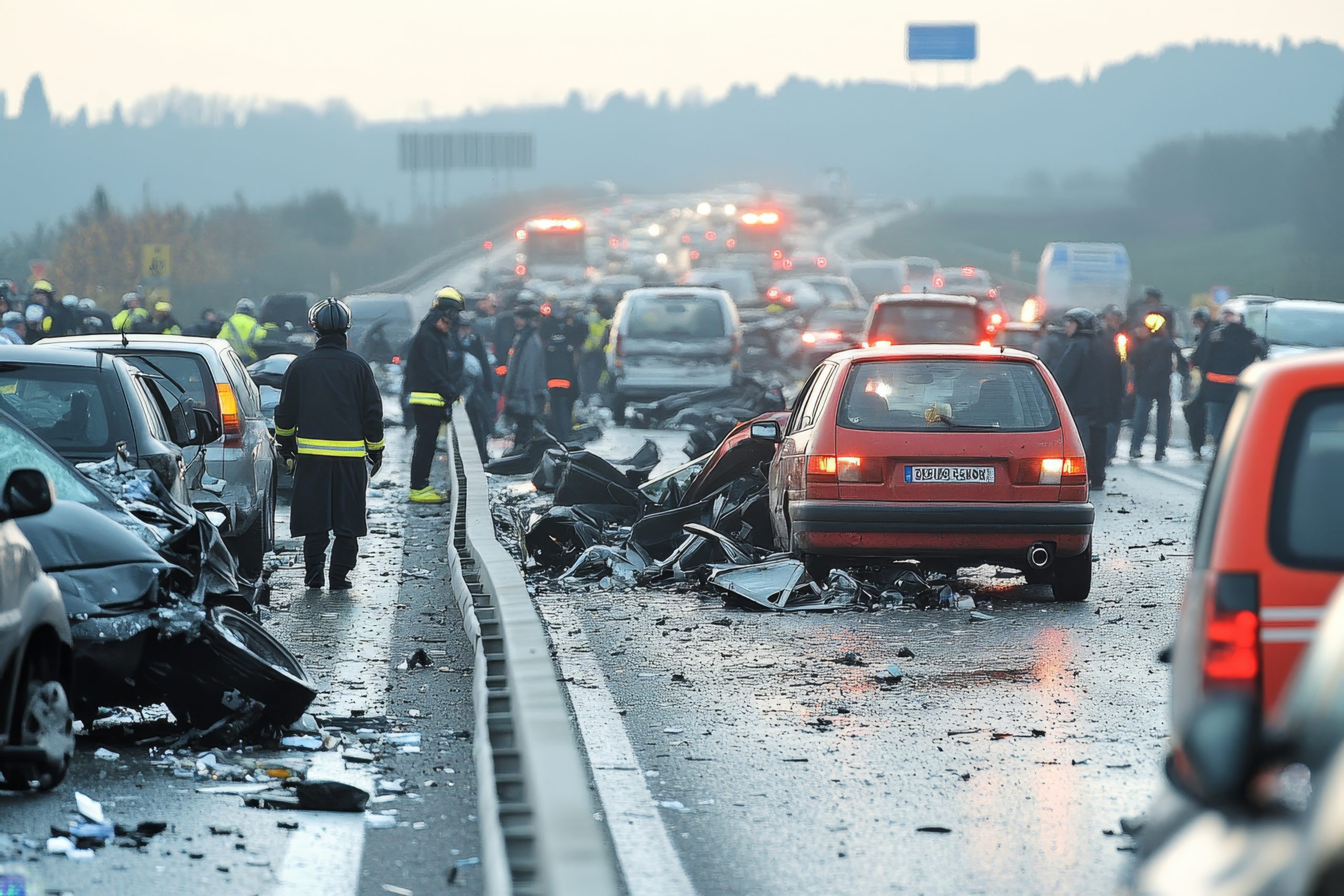
A multi-car pileup on a Georgia highway leaves drivers and passengers along with their families facing serious injuries, vehicle damage, a tangle of insurance questions, and unclear legal issues. Determining who is responsible and to what degree when multiple vehicles are involved in a single crash is an enormous challenge. Here is what you need to know about how fault is assigned under state law after a multi-car pileup in Georgia.
What Is a Multi-Car Pileup?
A multi-car pileup, also called a chain-reaction crash or multi-vehicle accident, involves three or more vehicles in a single incident. These types of car accidents typically begin with one collision that triggers additional impacts as multiple drivers react or are unable to stop in time. They are most common on high-speed Georgia interstates such as I-75 or I-285, where traffic volumes are high with compressed following distances, and the consequences of a single mistake can ripple through multiple vehicles.
What Causes Multi-Car Pileups on Georgia Highways?
Most multi-vehicle accidents trace back to one driver’s mistake that sets off a chain of collisions. Distracted driving is one of the most common triggers, since a driver who looks away for a moment may not register slowing traffic until it is too late. Tailgating compounds this risk, leaving drivers with too little time and distance to react when the vehicle ahead stops suddenly.
Speeding and aggressive driving, including rapid lane changes and weaving through traffic, are also frequent contributors, particularly on congested metro-Atlanta corridors. Weather and road conditions can be involved as well: fog or heavy rain and wet pavement reduce visibility and stopping time, making chain-reaction crashes more likely in bad weather when traffic volume is high.
What to Do Immediately After a Multi-Car Pileup in Georgia
The steps you take immediately after a crash affect both your physical recovery and the strength of any legal claim. The following actions help protect your rights:
- Call 911 and report the accident. A police report creates an official record that will be important for insurance and legal purposes.
- Seek medical attention promptly. Some injuries do not present symptoms immediately, and a timely medical record ties any diagnosed injuries directly to the crash.
- Document the scene. If it is safe to do so, photograph all vehicles involved, visible damage, road conditions, skid marks, and traffic signage.
- Collect witness information. Names and contact details from bystanders or other drivers can provide objective accounts of how the crash occurred.
- Report the accident to your insurance company. Notify your insurer promptly and provide factual information about the incident.
- Avoid giving recorded statements to any insurers before consulting an attorney. Adjusters have an interest in minimizing their payout, and early statements can be used against you.
How Is Fault Determined in a Multi-Car Accident in Georgia?
Determining fault in a multi-vehicle accident requires a careful review of available evidence. Investigators, insurance adjusters, accident experts, and attorneys look at the full sequence of events, not just who made first contact. The driver who initiated the crash tends to bear the greatest share of responsibility, but subsequent drivers who were following too closely, traveling too fast, maneuvering dangerously, distracted by devices, or otherwise inattentive can also be assigned a portion of fault.
Police reports, witness statements, traffic camera and dashcam footage, skid marks, vehicle damage patterns, and event data recorders (black boxes) all contribute to building a picture of how the crash unfolded and determining liability. In disputed cases, an Atlanta car accident lawyer can retain accident reconstruction specialists to synthesize this evidence and establish a reliable sequence of events.
What Happens If You Are Partially at Fault in a Georgia Pileup?
Georgia follows a modified comparative negligence rule, which means that more than one driver can share responsibility for a crash. Each driver involved is assigned a percentage of fault based on the evidence. Your ability to recover compensation depends on where your percentage falls.
If you are found to be 50% or more at fault, Georgia law bars you from recovering any compensation from other at-fault parties. If you are less than 50% at fault, you can still pursue a claim, but your recovery will be reduced by your share of responsibility. For example, if you have $100,000 in damages and are found 20% at fault, your recoverable amount would be reduced to $80,000.
Insurance companies will attempt to assign a higher percentage of fault to reduce their payout, so the way fault percentages are negotiated or litigated impacts what you are ultimately able to recover. Even a modest shift in the assigned percentage of fault can determine whether you receive any compensation at all.
How Insurance Companies Handle Multi-Car Pileup Claims in Georgia
Multi-car pileups involve multiple insurers, each representing a different driver and each motivated to minimize their client’s share of liability. Adjusters will conduct their own investigations, reviewing the same evidence, and more often than not will reach different conclusions about fault depending on their policyholder’s potential exposure. This creates prolonged disputes and conflicting determinations that lead to delays in settlement.
If the at-fault driver or other drivers carry insufficient insurance to cover your damages, your own uninsured or underinsured motorist coverage may provide an additional source of compensation.
How Long Do You Have to File a Claim After a Multi-Car Accident in Georgia?
In Georgia, the statute of limitations for personal injury claims is generally two years from the date the crash occurred. Claims for property damage carry a longer deadline of four years. Missing either deadline can forfeit your right to seek compensation, regardless of the strength of your claim. If a government vehicle or a minor was involved, separate notice requirements and deadlines may apply.
Injured in a Multi-Car Accident? The Georgia Car Accident Lawyers at Hoffspiegel Law Can Help
Multi-car pileups on Georgia highways create some of the most challenging liability questions in personal injury law. Establishing the sequence of events and gathering time-sensitive evidence while negotiating with multiple insurance companies simultaneously requires focused legal attention.
If you were injured in a multi-car pileup in Georgia, the attorneys at Hoffspiegel Law are available to evaluate your claim. Contact us to schedule a confidential consultation.
Send a Message
To The Hoffspiegel Law Team